
Best practices
June 30, 2026
How Public Agencies Can Use Polls on Nextdoor
# Polls
Updated guidance on how to use poll to achieve mission objectives

Joseph Porcelli
Every public agency communicator eventually faces the same question from leadership: Did this make a difference?
A standard post can't answer it. You can see how many people it reached, but you can't see whether the message landed, whether it changed understanding, or whether it moved anyone to act. That gap between getting information out and knowing whether it worked is one of the hardest problems in public-sector communications.
Polls close that gap.
A poll is a measurement tool as much as a communications one. Agencies use them to gather feedback, measure community sentiment, educate residents, establish baselines before a campaign, and ask directly whether residents took action after seeing their communications. That makes polls something most agencies don't have enough of: a measurement tool built into their communications.
Polls also happen to drive 3x as many interactions as standard agency posts on Nextdoor. That’s worth knowing when you're making the case internally.
Start Here: Your First Poll
If you've never posted a poll, start with this one. It's the most-used poll format among law enforcement, fire, and city government agencies on Nextdoor, and it works by replacing guesswork with direction.
Poll question: What type of information from our department would you find most helpful on Nextdoor?
Answer choices:
- Public safety updates and crime alerts
- Community events and programs
- Emergency preparedness tips
- Local news and agency announcements
- Programs and services for families
These choices represent the full range of options for various types of public agencies. Swap in options that reflect what your agency actually produces, post the poll, and let the results shape your upcoming content.
The Dallas Police Department asked a version of this question. So did the Indianapolis Metropolitan Police, Detroit Police, and Mecklenburg County. Agencies that run it consistently say it resets the relationship with their audience. Residents feel consulted rather than broadcast to.
Run it quarterly, and you gain something more valuable than a snapshot: a trend. The answers tell you whether residents want more public safety content or more community news, and tracking those shifts keeps your content relevant as their needs evolve.
What Agencies Are Actually Doing With Polls
Getting residents to reflect on their own safety
Fire departments have converged on a poll format that works because of its psychological dynamics. Instead of telling residents to test their smoke alarms, they ask when residents last tested them. Instead of telling residents to practice a home escape plan, they ask whether they have one.
"Which option best describes the last time you and your family practiced your home escape plan?" has been posted by more than 30 fire departments, including Snohomish Regional Fire & Rescue, Coral Springs Fire Department, and the Milwaukee Fire Department. The same format applies to smoke detectors, insurance deductibles, pet emergency plans, and evacuation readiness.
The poll doesn't instruct. It prompts residents to think about what they haven't done. That's a meaningful difference in how the message lands, and it produces real data. The distribution of answers tells agencies exactly where the preparedness gaps are in their community.
Try this: "When did you last test your smoke alarm?" with choices ranging from "this month" to "can't remember." Close the poll and repost it, sharing the results along with the correct guidance and testing instructions.
Measuring how residents feel
Some of the most useful poll results agencies have gotten on Nextdoor had nothing to do with communications preferences. When the Austin Police Department asked residents how safe they felt in their neighborhoods, 85% said they felt safe. When the Miami-Dade Police Department asked what the department should focus on, 54% said community policing, more than traffic enforcement and quality of life issues combined. When the St. Louis Board of Aldermen asked about a "dollar home" program to transform vacant properties, 93% expressed support.
Those numbers tell you how to allocate resources and shape messaging and sequence programs before you've committed to anything.
Try this: "How informed do you feel about what's happening in your neighborhood?" is a baseline you can return to every six months. The change over time is often more useful than the initial number.
Teaching through questions
Trivia-style polls let agencies cover serious topics without sounding like a public service announcement. The City of San Diego asked which items don't go in the green bin and got 2,651 votes. The City of Mesa runs a recurring "Let's Get Quizzical" series on what to flush, what to recycle, and open board positions. Thomasville Police Department runs "Traffic Trivia Tuesday." Schools have used polls to quiz residents on reunification protocols and security response procedures.
A question stops the scroll in a way a statement doesn't. A resident who would skip a recycling tip will pause to test their own knowledge. And the repost with the correct answer explained is what drives additional comments and shares.
Louisville Waste Management has run educational trivia polls for years as part of an ongoing effort to reduce recycling contamination. A recurring format with rotating questions can support a long-term behavior-change goal, not just a single campaign.
Try this: "True or false: pizza boxes can go in your recycling bin." One question, clear stakes, easy to answer, and the comment section writes itself.
Collecting genuine input before making decisions
The highest-engagement polls in Nextdoor's agency data are almost always the ones where the question is real, and residents sense their answer might actually matter.
Cook County Government asked residents what their highest priorities were for ARPA fund investment and got 2,580 votes. The Borough of East Washington asked what improvements residents wanted to see in the parks and received 3,870 responses, one of the highest totals in the data. The City of San Antonio Mayor and City Council asked how the city should spend $50 million in surplus funds. The City of Commerce City asked separately about housing, commercial development, transportation, and economic priorities, one topic at a time, to build a genuine picture of what residents wanted.
One thing to take seriously: if you run a poll asking residents to weigh in on a real decision, they will remember whether you told them what happened next. A follow-up post with the results and what you did with them is what earns the trust that makes the next poll worth taking.
Measuring whether your communications made a difference
This is the use case most agencies haven't tried yet, and it may be the most valuable.
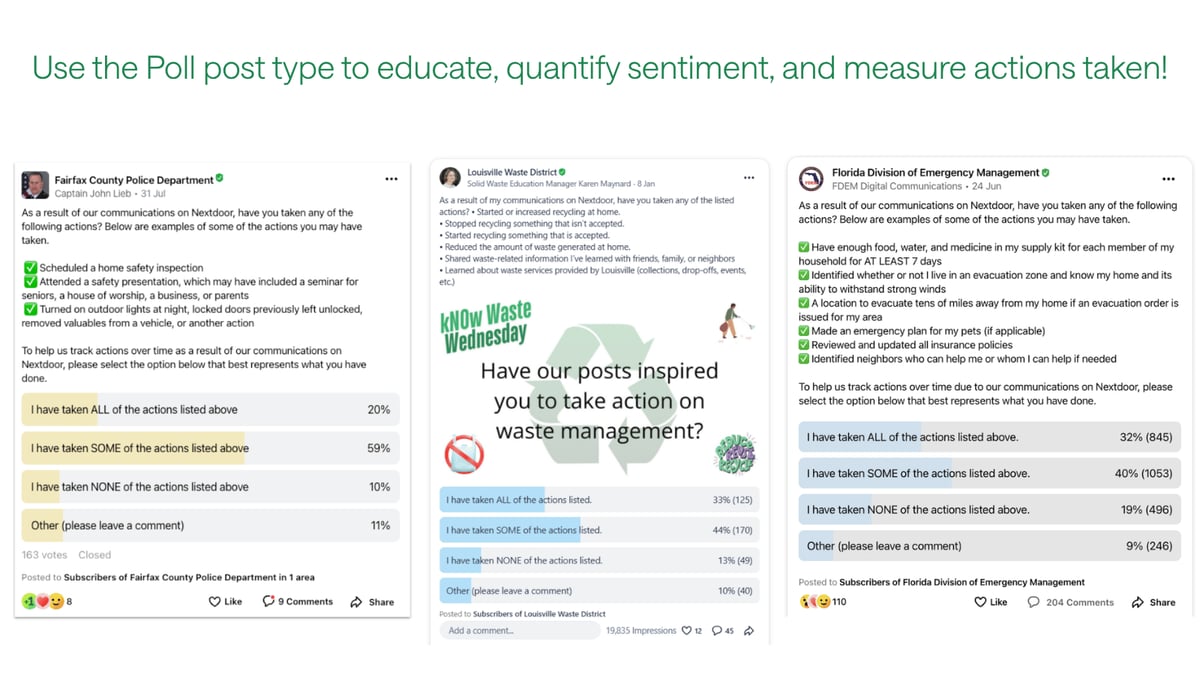
The Florida Division of Emergency Management used a poll to ask residents what actions they had taken as a result of the agency's Nextdoor communications. Thousands responded. CAL FIRE partnered with Harvard's National Leadership Institute to benchmark wildfire preparedness and assess whether neighbors were actively helping one another overcome barriers to action. According to that research, they were.
Every standard post your agency sends is a message you can't fully account for. A poll turns that post into a data point. The question that makes this work is straightforward:
"As a result of what we've shared on Nextdoor, have you done any of the following?"
That single question gives agencies something they rarely have: a direct line between their communications and resident behavior. It's the answer to what leadership eventually asks.
Try this: Run this poll at the end of a preparedness campaign. The results become your campaign report.
Tracking change over time
A single poll gives you a snapshot. A repeated poll gives you a trend.
During the pandemic, the City of Boston posted five consecutive weekly polls to track resident attitudes toward reopening, then cross-referenced the results with Waze mobility data to help inform city decisions. That kind of longitudinal view is available to any agency willing to ask the same question more than once.
Nextdoor recommends a quarterly poll cadence. It's enough to monitor whether sentiment is shifting and whether educational campaigns are improving understanding over time, without overwhelming your content calendar.
Before You Post
Polls can't be edited once published. Before you post, have a colleague read the question and answer choices as a resident would. A second set of eyes catches things you'll miss: a typo, an ambiguous answer option, a choice that doesn't apply to your agency type.
Keep polls open for 3 or 7 days. That gives votes time to accumulate and makes the final tally meaningful.
Repost with results. Once you close the poll, repost it with a summary of the results and the key takeaway. The results post often outperforms the original, and it closes the loop with residents who voted. Numbers worth sharing can also go to your other social channels or to local media when they're newsworthy.
Look at results by neighborhood or service area when you can. Download the results and examine the breakdown. The differences across communities are often as telling as the overall totals, and they'll shape where you focus next.
The Next Step
Pick one poll type from this page for prewritten examples in our Content Library. To learn more about the mechanics of polls, take this short online course.
Dive in
Related
Blog
What Public Agencies Need to Know About Advertising on Nextdoor
By Joseph Porcelli • Apr 16th, 2026 • Views 1.5K
Blog
Engagement Plans: Get the most out of Nextdoor for Public Agencies
By Joseph Porcelli • Feb 14th, 2023 • Views 599
Blog
Insights on how to effectively use Nextdoor Polls from the Greenfield Health Department
By Joseph Porcelli • Jan 23rd, 2023 • Views 299
Blog
Nextdoor for Public Agencies: Enhanced Features for Better Community Engagement
Jul 15th, 2025 • Views 133
Blog
What Public Agencies Need to Know About Advertising on Nextdoor
By Joseph Porcelli • Apr 16th, 2026 • Views 1.5K
Blog
Insights on how to effectively use Nextdoor Polls from the Greenfield Health Department
By Joseph Porcelli • Jan 23rd, 2023 • Views 299
Blog
Nextdoor for Public Agencies: Enhanced Features for Better Community Engagement
Jul 15th, 2025 • Views 133
Blog
Engagement Plans: Get the most out of Nextdoor for Public Agencies
By Joseph Porcelli • Feb 14th, 2023 • Views 599