
Product announcements
April 16, 2026
What Public Agencies Need to Know About Advertising on Nextdoor
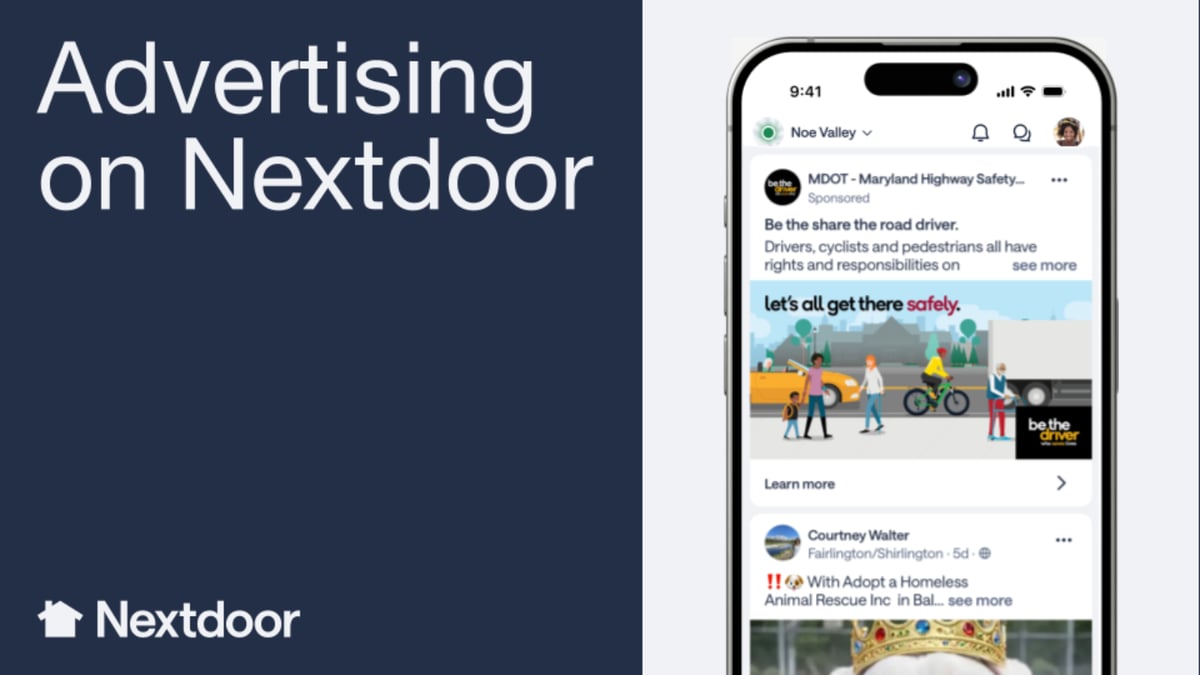
# Advertising
A conversation with our ads team that every government communicator should hear

Joseph Porcelli
Advertising on Nextdoor isn't new, but the depth of what it can do for public agencies — the targeting, the measurement, the AI-powered optimization — is something I wanted to document properly. So I sat down with my colleague Taylor Mountain, a Client Partner on the Nextdoor Ads team, and asked her to walk me through everything. What followed was one of those conversations where I kept thinking: agencies need to hear this.
The free platform gets you in the room. Ads get you results.
The first thing I wanted to clarify for anyone watching: there are two distinct things here, and they work together. The Nextdoor for Public Agencies platform — the one you already know — is free. It gives you access to a built-in, verified audience and lets you geotarget posts by geography. That's genuinely valuable, and I'm never going to tell you not to use it.
But it has a ceiling. When you post organically, you don't control who sees it. You can't guarantee distribution. You can't measure whether anyone clicked a link, signed up for a program, or took action as a result. That's where ads come in.
You're not reaching just any audience. You're reaching the household CEO.
Taylor made a point early in our conversation that I want agencies to sit with for a second. Every person on Nextdoor is verified by their name and home address when they sign up. You're not buying impressions against anonymous profiles. You're reaching real people where they actually live.
And these aren't passive scrollers. Nextdoor users come to the platform actively looking for something — a local contractor, a flood grant, information about a new health program. That high-intent mindset is genuinely rare, and it matters for public agencies whose job is to get people to do something, not just be aware of something.
Then there's this: Nextdoor reaches people you're missing everywhere else.
- 20% of Nextdoor users are missed by Facebook advertisers
- 53% of Nextdoor users are missed by X advertisers
- 1 verified home address per user — always
That last point is what Taylor calls the "household CEO" — the person making decisions for the whole family. The one packing the go-bag. The one researching contractors, vetting health plans and deciding where the kids get vaccinated. That's who agencies are trying to reach, and that's exactly who's on Nextdoor.
There are multiple ad formats to choose from in addition to Display, which most agencies use:
Taylor also recommended the carousel format for agencies. You can swipe between tiles and link each one to a different resource or program — and you can track which tile got clicked. A health department running a carousel with links to dementia resources, summer youth programs, and vaccine locations can see which links people clicked. That's a level of insight most agencies have never had.
Click-to-call is brand new, and it's exactly what it sounds like. One tap and a resident is dialing your government hotline or information line. No copy-paste, no searching for a number. Just an immediate connection.
Lead generation ads let you collect information or tips directly on the platform. Taylor mentioned one agency using this to collect tips about environmental violations — with built-in immediate follow-up capability. That's a real workflow, not a workaround.
Choose from many targeting options as well, including current location (not available on free Nextdoor for Public Agency pages).
The free public agency platform lets you target by geography — where people live. Ads open that up considerably. You can target by current location, which means you can reach people who work in your jurisdiction but live somewhere else. For agencies managing border geographies or regional programs, that's a meaningful capability that simply doesn't exist on the organic side.
But the targeting goes further. During our conversation, I mentioned fire departments and the grill fire season that predictably shows up every spring. I asked Taylor whether a fire department could run an ad against anyone talking about grilling or barbecuing. She told me there's actually a barbecuing segment already on the platform. That's the level of specificity we're talking about.
Beyond interests, you can target by income (essential for income-based programs), homeownership status, age of home, family composition, and life stage. The “recent movers” segment is one Taylor always recommends — residents who are new to their neighborhood, actively looking to connect, and more likely to engage with local government resources than almost anyone else on the platform.
You can also bring your own audiences. Upload a CSV of emails or zip codes — people who've signed up for a newsletter, attended a program, or called a hotline — and target them directly. Or suppress them so your budget goes toward finding new people rather than talking to folks you've already reached.
AI does the heavy lifting. You set the parameters.
Most agency communicators aren't running ad campaigns full-time, and the platform is built with that in mind. It uses machine learning to optimize who sees your ad based on behavioral signals from across Nextdoor — what people search for, what they engage with, what groups they're in. You don't have to tune it manually every day. You set your objective, set your parameters, and let it run.
The machine gets smarter over time. Taylor says you usually start seeing meaningful optimization around the two-week mark. For agencies used to sending a press release into the void and hoping for the best, that's a fundamentally different relationship with your audience.
There's also a hyper-local personalization feature worth calling out. If you're running a statewide campaign, you can drop a simple city or neighborhood macro into your ad copy and it dynamically fills in based on where the viewer lives. Instead of "Hey Virginia, find your nearest vaccine location," it reads "Hey Alexandria" or "Hey Roanoke." Same creative, same landing page — just a small change that makes it feel like you built it for them.
Measurement is built in.
One of the most common questions I get on the public agency side is some version of: "How do we know this worked?" With organic posts, it's hard. With ads, Taylor showed me exactly how it works. You can track clicks, website visits, program sign-ups — and if you have multiple conversion points (program A, program B, program C), you can see which one drove action. You can tie spending to outcomes and report back up the chain with actual numbers.
For agencies that have to justify every budget line, that's not a nice-to-have. That's the whole game.
Getting started is simpler than you think.
If you already have a Nextdoor public agency page — and you should — you go to ads.nextdoor.com/v2/login and sign in with your existing credentials. Don't create a business page. Don't start over. Your public agency login grants you access to the ads platform with full functionality intact.
There's no minimum budget that should scare anyone away. Taylor recommended a lifetime budget approach — set your total spend and your campaign window, and the platform handles the pacing. If you have $100 to promote a summer camp registration, you can do that. If you have $20,000 for a seasonal preparedness push, you can do that too.
Nextdoor ads have capabilities that most agencies haven't fully tapped yet. If you've been sitting on the fence — or didn't realize how different it is from the free platform — I hope this conversation changes that.
Ready to get started?
Existing public agency partners can sign in at ads.nextdoor.com/v2/login using your current Nextdoor credentials.
New to Nextdoor entirely? Start at ads.nextdoor.com to create your account.